
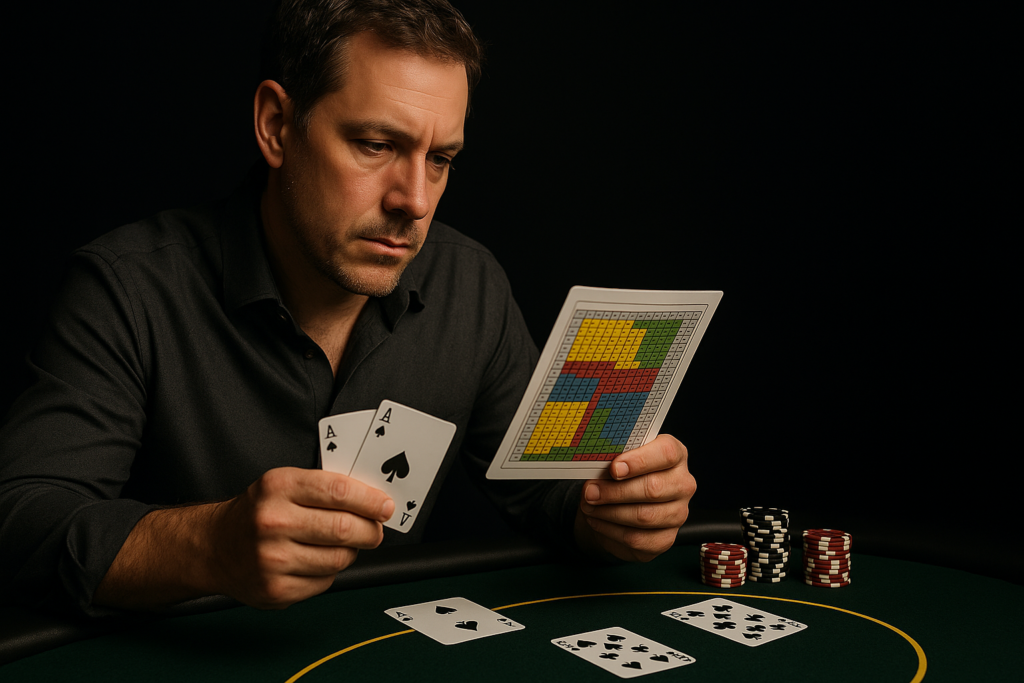
Blackjack Basic Strategy Chart: Use the 4–8 Deck S17 Chart to Cut the House Edge to ~0.4% (Examples, Drills, and Rule-Check Checklist)
Estimated reading time: 6 minutes
Key takeaways
- Use a four-to-eight-deck S17 chart when the dealer stands on soft 17 in shoe games to approach a ~0.4% house edge.
- Match the chart to the table rules: decks, S17 vs H17, doubling/splitting limits, surrender, and peek/no-peek.
- Drill hard totals, soft hands, and pairs separately until decisions become reflex.
- Rule changes (H17, more decks, no-peek, restricted doubles) add a few tenths of a percent to the house edge.
Pick the right blackjack basic strategy chart: a quick checklist
First rule: don't assume one chart fits all.
Basic strategy depends on the table rules — decks, S17 vs H17, doubling rules, splitting limits, surrender, and whether the dealer peeks for blackjack.
- Count the decks: is it single, double, or shoe (4–8 decks)?
- Check dealer behavior: does the dealer stand on soft 17? (S17) Or hit? (H17)
- Look for doubling/splitting limits and whether late surrender is allowed.
- Notice no-peek rules (common in some European games).
If the table is a shoe game with the dealer standing on soft 17, grab a four-to-eight-deck basic strategy chart and use that.
Wizard of Odds and William Hill both publish matching charts for S17 and H17 situations, so match the rules, not the table decor.
What's in the 4–8-deck S17 blackjack strategy chart
Okay, what does the chart actually say? It's a grid: your hand total on the left (separated into hard totals, soft totals, and pairs), the dealer's up-card across the top.
Each cell tells you whether to hit (H), stand (S), double (D), split (P), or surrender (R).
Three sections you'll use every hand:
- Hard hands — totals without an ace counted as 11 (e.g., 16, 12, 11).
- Soft hands — hands with an ace counted as 11 (e.g., A-6 is “soft 17”).
- Pairs — whether to split identical cards (A-A, 8-8, 10-10).
For multi-deck S17 games the common rules are:
- Stand on hard 17 or higher.
- Stand on hard 12 vs dealer 4–6 and stand on hard 13–16 vs dealer 2–6; hit otherwise.
- Split aces and eights; don’t split fives or tens.
- Double hard 10 or 11 against weaker dealer up-cards when allowed.
- Don’t take insurance or even money as a routine play.
Those lines are summarized from standard multi-deck charts — the Wizard of Odds four-deck strategy page lays this out neatly for reference.
Reading hard, soft, and pair sections — step-by-step examples
Charts are easy once you know where to look.
Walkthroughs make them stick.
Here are three hands I see every session:
Hard 16 vs dealer 10
Look under hard totals: find “16” row, then the column for dealer 10. The four-to-eight-deck S17 chart says: hit.
Why? Against a dealer 10, your chance of surviving a hit is small, but standing commits you to losing most of the time.
The math says take the hit — it's the play that minimizes long-term loss.
Hard 11 vs dealer 6
Find “11” in the hard section, column dealer 6: double.
If doubling's allowed, put a unit on it and take exactly one card.
Doubling here is brutal-good: you have a strong chance of reaching 18–21 while the dealer is in a weak up-card position.
On a six, the dealer bust probability is much higher than usual — exploit it.
Pair of eights
Open the pairs section: 8s vs any dealer card — split.
Always. Even against a dealer 10.
Splitting 8-8 turns a doomed 16 into two chances to make hands that can beat the dealer.
The chart isn't emotional; it's arithmetic.
How correct play cuts the house edge (and how rules push it back up)
Here's the payoff: the right chart shrinks the casino advantage to a whisper.
In a six-deck game where the dealer stands on soft 17, Wizard of Odds calculates the house edge at roughly 0.41% when you use correct basic strategy, compared with about 0.93% for a simplified strategy.
That's concrete: switch from sloppy to correct, and the casino’s edge roughly halves.
See the Wizard of Odds six-deck example for those numbers.
But the edge isn't fixed. Add rule changes and you're backtracking:
- Move from S17 to H17 and the house edge increases by roughly 0.2 percentage points, according to William Hill.
- More decks generally increase the edge: Wizard of Odds shows edge rising from ~0.014% with one deck to ~0.577% with eight decks under its assumptions.
- No-peek rules and restricted doubling (or no surrender) also add a few tenths of a percent; for example, a European six-deck game with no peek and restricted doubles sits around 0.62% per Wizard of Odds' European strategy notes.
So a table labeled S17 and four-to-eight decks is where you get closest to that ~0.4% edge.
If the table switches to H17, adds more decks, or removes doubling/surrender, you need a different chart and to expect a higher casino advantage.
Practice drills with a blackjack basic strategy chart
Charts don't stick by osmosis.
Drill the decisions until they become reflex.
Here are practical drills that take 10–15 minutes each.
Drill 1 — Hard totals flash
- Write down every hard total 8–17 on index cards (or use an app flashcard).
- Random dealer up-cards; call out your decision using a basic strategy chart six-deck if you want the typical shoe-game situation.
- Score yourself: miss fewer than 2 per 20 on three rounds and you’re doing well.
Focus on the tricky ones: 12 vs 2–3, 16 vs 10, and 11 vs dealer's strong cards (where you sometimes still double).
Drill 2 — Soft hands and pairs
- Shuffle only combos that include an Ace and totals 13–18 (A-2 through A-7). Practice the soft table of the chart.
- For pairs, run 20 pair scenarios randomly and commit to split or not-split without looking more than a second.
Soft hands and pairs have more exceptions; they're where a lot of players wobble.
Drill them separately.
Drill 3 — Table-scan checklist
- Walk the floor (or the app) and scan five tables in 10 minutes, calling out the rule set and which chart you'd use: “shoe, S17, doubles allowed, surrender no — four-to-eight-deck S17 chart.”
- Make the checklist habitual: decks → S17/H17 → doubling rules → surrender → peek/no-peek.
That last drill is gold.
If you can scan a table and announce the right chart in seconds, you avoid one of the biggest mistakes players make: using the wrong strategy for the rules.
Common rule traps and what to do
There are table quirks that change the math and your moves.
Short list, practical fixes:
- H17 tables: Use an H17 chart. Expect about +0.2% higher house edge than S17; adjust bankroll and temper expectations.
- More decks: If the shoe looks thick (6–8 decks), don't use a single-deck chart — use a four-to-eight-deck chart instead.
- No-peek European rules: Dealer may not check for blackjack, which changes when you should surrender and whether side-payments like double after split differ. Use the European-specific chart for those tables.
- Restricted doubling: If you can't double after splitting or only on certain totals, your chart changes — find the matching variant.
Wizard of Odds' European strategy page is a good reference if you run into that no-peek variant at a table.
One responsible-play note: basic strategy reduces the house edge but doesn't erase it.
Set time and money limits, and don't assume small house edge means guaranteed winnings.
Blackjack basics is a nice refresher on what the game actually is if you want that foundation.
Quick checklist to choose the matching chart at any table
- Step 1: Count decks. If it's a shoe (4–8), use the four-to-eight-deck chart.
- Step 2: Check dealer: S17 or H17? Pick S17 chart if dealer stands on soft 17.
- Step 3: Note doubling/splitting/surrender rules and whether dealer peeks for blackjack.
- Step 4: If unsure, choose the chart that most closely matches the rules — conservative play is better than a mismatched aggressive tweak.
If you want a quick one-line memory: decks first, then dealer rule, then doubling/surrender, then peek.
Say it once and you'll stop using the wrong chart by accident.
Four-deck strategy pages are a practical example of how slightly different charts are laid out for shoe play.
One nuance: many online or bar-style games will let you play the basic S17 chart and be within a few tenths of optimal if other rules are similar.
But when a table is H17, or uses eight decks, those tenths add up fast across hours.
Remember that the goal of the blackjack basic strategy chart is to minimize the casino's statistical edge, not to guarantee wins.
With the right S17 chart for four-to-eight-deck games, you're aiming at roughly a 0.4% disadvantage; stray from the matching chart or accept worse rules and that advantage inflates by roughly 0.2–0.6 percentage points, per the rule changes we've discussed.
Four-to-eight-deck strategy references and the William Hill overview are both good bookmarks for on-floor checks.
Conclusion
If you want the smallest, most reliable casino edge at a shoe table, learn the blackjack basic strategy chart for four-to-eight-deck games with the dealer standing on soft 17.
Match the chart to the table rules, drill the hard, soft, and pair decisions until they’re reflex, and remember that rule changes like H17, extra decks, or no-peek can add a few tenths of a percent to the house edge — enough to matter over long sessions.
Frequently Asked Questions
What is a blackjack basic strategy chart and why should I use one?
A blackjack basic strategy chart is a grid that tells you the mathematically best play (hit, stand, double, split, surrender) for every player hand against every dealer up-card, given a specific rule set. Use it because it cuts the house edge dramatically compared with guesswork; in a six-deck S17 game basic strategy reduces the edge to about 0.41% per Wizard of Odds.
Do I need a different chart for six-deck games?
Yes. A basic strategy chart six-deck or any four-to-eight-deck chart matches the shoe dynamics better than a single-deck chart. The number of decks changes card distributions and therefore optimal play; Wizard of Odds shows the edge shifts as deck count changes.
Which is better: S17 or H17 strategy charts?
Use the chart that matches the table. If the dealer stands on soft 17 (S17), use an S17 blackjack chart — it generally gives you about 0.2 percentage points lower house edge than the H17 equivalent, per William Hill's analysis.
Can I use one chart for both online and live tables?
Only if the rules match. Online lobbies will usually list decks and dealer behavior. If the online game says “6-deck, S17” then a four-to-eight-deck S17 chart applies. If the live table has different doubling or surrender rules, use the chart that matches those exact rules.
Is insurance ever a good idea when using basic strategy?
No. Standard basic strategy advises against insurance or even money as a routine play. Insurance is essentially a separate bet with a negative expected value under normal rules.
How much practice do I need to internalize the chart?
Short drills — 10–15 minutes a day for a week — usually get you comfortable with most hard totals and common soft/pair situations. Use flashcards for hard totals and focused drills for soft hands and pairs until the decisions are automatic.