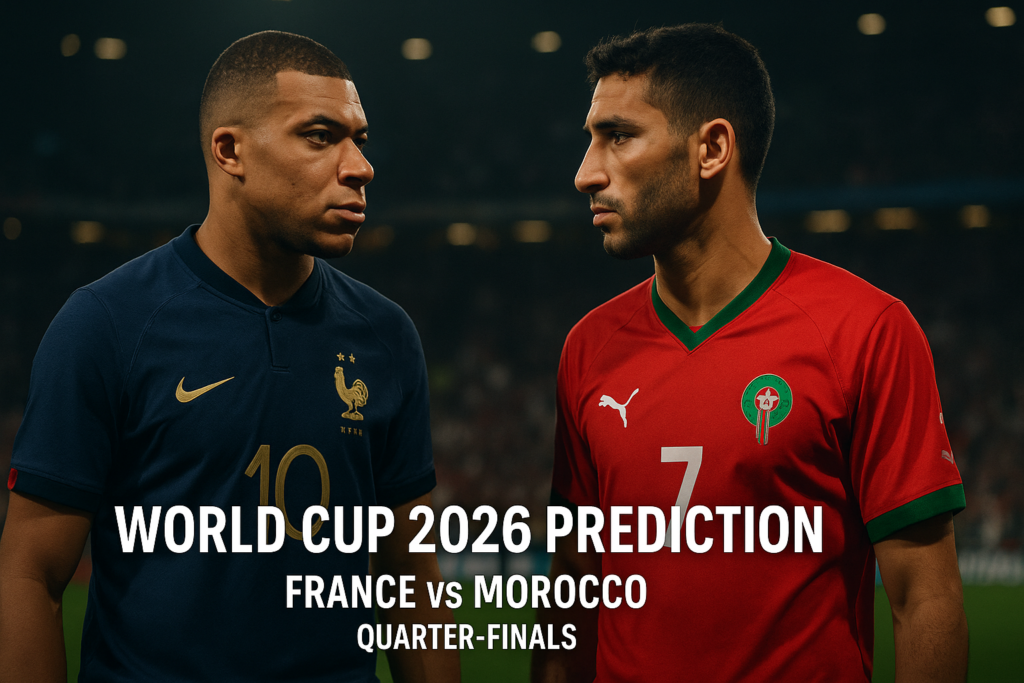
World Cup 2026 quarter-final preview: France vs Morocco — who has the edge?
If you're picturing a France vs Morocco quarter-final at the 2026 World Cup, you're not alone — it's a matchup that sells itself. France brings depth, star power and recent World Cup pedigree. Morocco carries defensive discipline, continental momentum and the tactical nous to frustrate the best attacks. Here's why this hypothetical tie matters, what would realistically decide it, and how bettors and fans should think about the market without getting carried away.
Why this matchup would be compelling
France are one of the modern football superpowers: two World Cup titles (1998, 2018), finalists in 2022, and a squad that traditionally blends elite attackers with a deep bench. Morocco, meanwhile, rewrote expectations at the 2022 World Cup by becoming the first African team to reach the semi-finals — a run built on compact defending, quick counters and excellent team shape.
This matters because it’s not just a clash of styles; it’s a clash of narratives. France has the firepower and expectations. Morocco has the momentum and the underdog aura that can make opponents second-guess themselves. In a knockout tie, small margins decide everything.
How the teams arrived at this stage (context and form)
First: the tournament backdrop. The 2026 World Cup expands to 48 teams across the US, Canada and Mexico, which changes scheduling, travel and group dynamics compared with 2018 and 2022. That can favour nations with deeper squads — a point in France’s favour — but it can also produce surprise challengers who ride one fantastic run, like Morocco did in 2022.
Looking back at recent tournaments gives us useful context. Kylian Mbappé finished as top scorer at the 2022 World Cup with eight goals, and France reached the final before losing on penalties. Morocco’s 2022 campaign featured wins over Spain and Portugal en route to the semis, and their defensive organisation underpinned that historic run.
Form into the quarter-finals in any World Cup can be deceptive. A team playing poorly in group stages can peak at knockout time; conversely, a side cruising through the groups can hit a wall. So, while France might enter as favourites on paper, the real issue is: which version of each team shows up on the day?
Tactical matchups: where the game would be won and lost
Here’s the interesting part: the contest is less about individual brilliance and more about phases of play.
France — controlling the game through possession and transitions
France typically tries to control matches through a mix of possession and explosive transitions. Their biggest strengths are pace in attack, direct dribbling, and quick vertical passing that can punish teams when they commit players forward.
This matters because Morocco are happiest sitting compact and inviting pressure. For France, the problem becomes how to break a low block without overcommitting and getting caught on the counter.
Morocco — disciplined defence, fast counters, set-piece threat
Morocco’s success in 2022 hinged on a clear blueprint: a rigid back line, midfielders who break passing lanes, and attackers who hit at pace when they win the ball. They also proved dangerous on set pieces and from dead-ball situations.
That combination can stifle free-flowing teams. If Morocco can slow France’s tempo, win duels in midfield and exploit the spaces left by advanced fullbacks, they have a real path to victory.
Key players and matchups to watch
In any France vs Morocco tie, three duels would largely define the result: France’s forwards vs Morocco’s central defenders; Morocco’s wingers/fullbacks vs France’s fullback space; and the midfield battle for control and transitions.
- France’s frontline — Speed and finishing: France’s threat will be pace and clinical finishing. Who can convert half-chances will be decisive.
- Morocco’s central block — Organisation and aerial strength: Morocco has shown an ability to keep shape and win headers and second balls, which blunts long-range or aerial attacks.
- Midfield control — Transition moments: Whoever wins the 50/50 midfield battles will provide the platform for dangerous counters or sustained pressure.
Of course, personnel by 2026 may differ. Players age, new stars emerge, and managers change systems. But the underlying conflicts — pace vs compactness, transition vs control — will still be central.
Betting angles and market thinking
Let’s be practical: markets favour clear edges but smart bettors look for nuance. If you’re following odds, watch lines shift around injuries, starting XI news and venue details.
Common market patterns you’ll likely see:
- France as favourites: Expect them to open as favourites given squad depth and history. That often means markets like France -1 (Asian handicap) will be popular.
- Under/Over goals: Markets may offer attractive value on under markets if Morocco’s defensive identity is intact; conversely, if France’s attack is clicking, over lines can shorten quickly.
- Both teams to score (BTTS): This is a key market — France can score; Morocco can nick a goal on the break or set-piece. Movement toward BTTS yes or no will tell you how the market is reading defensive solidity vs attacking threat.
- Live betting value: In a tight match, live markets (corners, cards, next scorer) often present better edges than pre-match outright bets.
This matters because early public money tends to be on favourites; sharper bettors look for price changes after lineups are announced. Responsible note: always manage stakes and don’t chase losses.
Here are a few practical angles some bettors might explore:
- Consider France draw-no-bet or -0.5 Asian handicap if you like them but want some protection.
- If Morocco’s defensive record through group/knockouts is strong, look at under 2.5 goals or BTTS No as potentially undervalued options.
- Market reaction to starting XIs: if Morocco names a particularly defensive midfield, the under and BTTS No will likely shorten — that tells you the market’s fear of a 0–0 or 1–0 outcome.
Remember: odds reflect both objective factors and public sentiment. Line movement can teach you more than static numbers. For market comparisons and live odds tracking, outlets like Oddschecker collect lines across bookmakers and can be a useful starting point: Oddschecker World Cup markets.
Responsible gambling: Betting should be entertainment, not income. Set limits, don't bet more than you can afford to lose, and seek help if gambling becomes a problem.
Venue, crowd and intangibles
Unlike club matches, World Cup knockout ties come with travel, crowd dynamics and atmosphere that can tilt the scales.
In 2026 the tournament will be shared across three countries. Venue choice affects everything: altitude, weather, pitch surface, and crowd composition. Morocco benefits from large diasporas in several North American cities; they can produce a sea of supporters that gives the team a feeling of home away from home. France’s fans travel well and the French national team enjoys strong worldwide support too.
This matters because one late second-half corner or an early controversial decision can be magnified by the crowd. Momentum swings in knockouts are real, and teams that control temperament often win ties as much as those with technical superiority.
How to interpret “upsets” and the role of small margins
The best part about knockout football is its randomness. A single moment — a penalty, a red card, a stoppage-time header — can swing a tie. Morocco’s 2022 run showed that a compact, well-organised team with tactical clarity can beat more fancied opponents.
So when you hear that France are overwhelming favourites, remember: favourites lose in knockouts all the time. The smart angle is to assess probability rather than rely on reputation.
Where to find authoritative information and live updates
For reliable tournament info and official updates, check these sources:
- FIFA — official 2026 World Cup hub
- French Football Federation (FFF) — squad and official announcements for France
- Royal Moroccan Football Federation (FRMF) — Morocco’s official federation site
FAQ
1. Would France always be favourites against Morocco in a 2026 quarter-final?
Not “always,” but usually. On paper, France’s depth and pedigree make them favourites. That said, team form, injuries, manager tactics and match context (venue, travel, weather) all influence odds. Market odds reflect both perceived strengths and public betting patterns.
2. Can Morocco realistically beat France in a quarter-final?
Absolutely. Morocco proved in 2022 that disciplined, organised teams can beat Europe’s best. In a single knockout game, tactical clarity and defensive organisation can neutralise star attackers. If Morocco executes their plan and capitalises on transitions or set pieces, they have a genuine path to victory.
3. What tactical setup should France use to break Morocco down?
Effective approaches include quick rotations to shift defensive blocks, wide overloads to stretch the backline, and patient build-up to draw Morocco out and create pockets of space. Transition patience is key — overcommitting invites counters.
4. Which betting markets are worth watching for this tie?
Pre-match: match result, Asian handicap and under/over goals are primary. In-play: next goal, corners and cards can offer value. Watch how odds move after the official lineups are released; that movement often signals where sharp money is going.
5. How much does venue affect the outcome?
Quite a bit. Crowd composition, climate and travel fatigue can alter performance. A friendly or neutral crowd is different from a packed partisan stadium. In 2026, travel distances across the host countries will add a layer of complexity compared with recent tournaments.
6. Is the 48-team format in 2026 relevant to how this quarter-final would play out?
Yes. More teams and a revised group stage can change match fitness, rotation patterns and fatigue levels heading into knockouts. Teams with deeper benches (like France) theoretically benefit, but momentum and tactical form still trump depth sometimes.
7. How should casual fans bet responsibly on such a match?
Set a budget, stick to it, and use small stake sizes for high-variance markets. Consider low-variance options like draw-no-bet or handicaps if you want protection. Avoid chasing losses and be mindful that unpredictable events (refereeing decisions, injuries) can decide a knockout tie.
8. Where can I check official starting lineups and live odds?
Official lineups usually appear on federation sites and tournament pages shortly before kickoff. For odds aggregation and live market movement, services like Oddschecker are helpful to compare bookmaker lines in real time.
Conclusion — the key takeaway
France vs Morocco in a World Cup quarter-final is a classic match-up of style and story. France brings firepower, depth and a winning history; Morocco brings organisation, compact defending and the tactical discipline to force upsets. In knockout football, the margin for error is tiny — one mistake or one moment of brilliance can flip the tie.
If you’re a fan, expect a chess match with flashes of brilliance. If you’re a bettor, focus on how the market reacts to starting lineups, injuries and venue details, and keep stakes sensible. Above all, remember football’s beauty in knockouts: it rewards preparation but delights in unpredictability.
Want to dig deeper? Follow official tournament coverage and federation updates and keep an eye on odds movement as kickoff approaches. And if you plan to bet, do so responsibly — it’s part of the entertainment, not the endgame.